
From AI PoC to production: the engineering system around the model
A technical playbook for turning an AI prototype into a system you can evaluate, trace, operate, secure, and scale.
 Bart LuderaCEO
A working AI proof of concept is relatively easy to build now.
Take a model, connect a few tools, add retrieval, spend some time on the prompt, and you can have an impressive demo within days. It answers the prepared questions. It calls the right API. People in the room can see the potential.
Then somebody asks the production question.
Can we rely on this system every day, across thousands of inputs, when data changes, APIs fail, models are replaced, and users do things nobody included in the demo script?
That question has very little to do with the polish of the prototype. A PoC proves that a capability might be useful. Production requires evidence that the entire system can be operated safely and improved without guesswork.
Many teams start with model selection. Dependable AI projects often reverse that order and build evaluation data, tracing, and measurement before comparing candidate models.
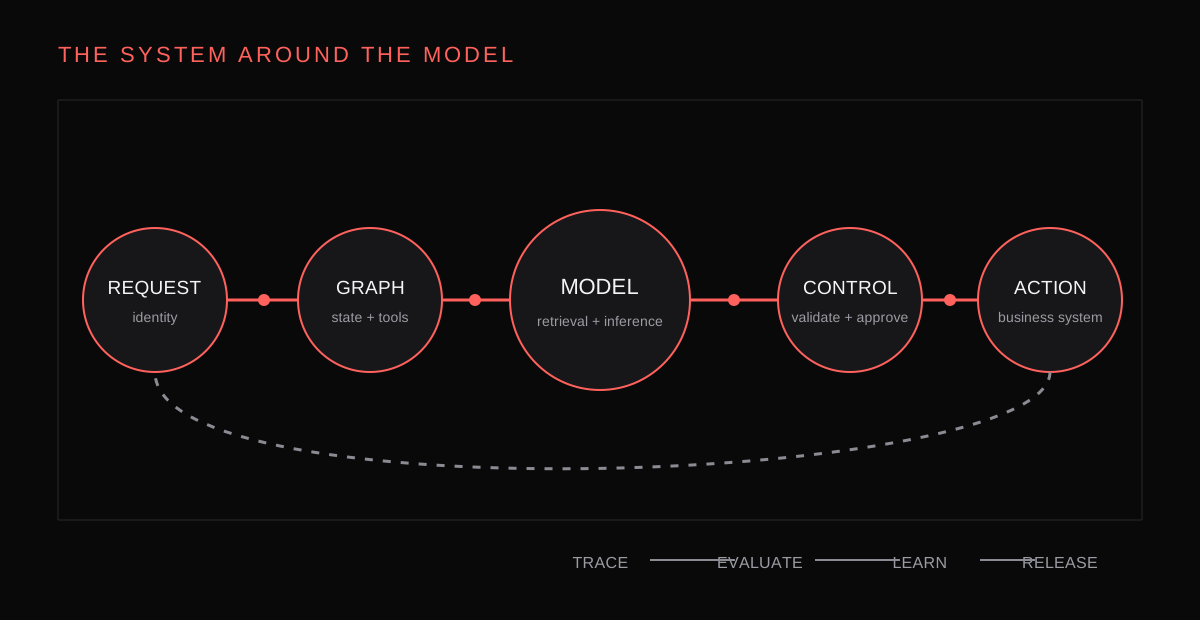
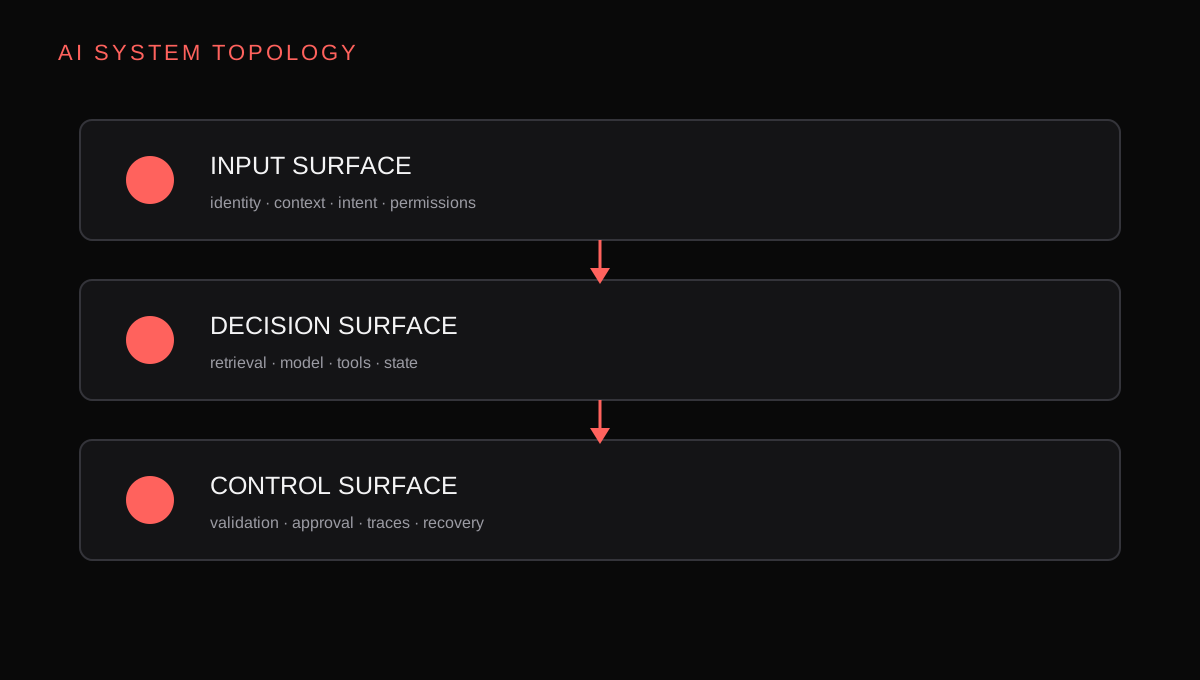
The hard part is not getting an LLM to produce a good answer once. It is building the engineering system around the model so you can define good, explain bad, recover from failure, and know whether a new version is safe to ship.
A demo shows capability. Production requires control
The mental model for a PoC is often this simple:
User request
    ↓
Prompt and context
    ↓
Model
    ↓
Answer
An agentic prototype adds retrieval and tools, but the focus stays on the happy-path result. The production system has a much wider boundary.
User
  ↓
Identity and permissions
  ↓
API gateway
  ↓
Stateful orchestration ←──── traces and evaluations
  ↓                              ↑
Model and tool routing           │
  ↓                              │
Retrieval ←──── freshness, ACLs, lineage
  ↓
Output validation
  ↓
Approval or automated action
  ↓
Business systems

Every step → logs, latency, cost, alerts, rollback data
The model is one dependency inside this system. It may not be the hardest one.
The production work falls into five connected areas: evaluation, observability, data, orchestration, and governance. Under all five sits ordinary production engineering. Timeouts, idempotency, queues, access control, deployment isolation, and incident response do not disappear because one component is probabilistic.
This is also where the LangChain ecosystem maps well to the problem. LangChain provides model and tool integrations, structured outputs, and middleware. LangGraph handles explicit state and durable execution. LangSmith connects traces, datasets, and evaluations. None of them replaces system design, but together they cover much of the operational surface that a demo usually ignores.
Start with a production contract, not an agent
The first mistake often happens before anyone writes code.
A team says, "Let's build an agent and see how well it works." That leaves the release standard undefined until after the team has become attached to the implementation.
Write a production contract first. It should describe the task, the allowed failure modes, and the numerical gate for release. For a support agent, a simplified version might look like this:
task_success: above 94 percent
critical_error_rate: below 0.1 percent
grounded_answers: above 97 percent
pii_leakage: zero known cases
p95_latency: below 5 seconds
human_escalation: below 15 percent
cost_per_completed_task: below 0.20 USD
Those numbers are not universal. A copywriting assistant and a payment approval system need different contracts. What matters is agreeing on the contract before model quality becomes a subjective debate.
Build the evaluation dataset from real work
Ten prompts written by the developer are a demo set, not an evaluation dataset.
A useful dataset represents the work the system will encounter. It needs ordinary cases, uncommon but valid inputs, missing data, contradictory sources, attempts to manipulate instructions, requests that should be refused, and cases that require escalation.
You do not need thousands of examples to begin. Twenty to fifty carefully selected cases are enough to expose major design problems. The dataset should then grow from production evidence.
Every meaningful failure should become a regression case:
Production failure
        ↓
Root cause analysis
        ↓
Dataset example
        ↓
Implementation fix
        ↓
Offline evaluation
        ↓
Controlled deployment
This loop matters more than the initial size of the dataset. A static benchmark gets stale. A dataset fed by real failures becomes a memory of what the system must not break again.
LangSmith separates offline and online evaluation in a useful way. Offline evals run against curated datasets before deployment. They support regression tests, backtesting, and comparisons between prompts, models, retrieval strategies, or graph versions. Online evaluators score production traces and help surface new failure modes. The highest-value workflow connects the two: a bad production trace is inspected, added to a dataset, fixed, and tested offline before the next release.
There is no single AI accuracy score
An aggregate accuracy number hides too much.
For a retrieval system, you may need retrieval recall, document relevance, answer correctness, groundedness, citation accuracy, and completeness. For an action-taking agent, the useful signals include task completion, tool selection, argument validity, forbidden actions, escalation quality, and trajectory length.
Latency, token usage, cost per completed task, policy violations, and PII exposure apply across both.
Use the simplest evaluator that can reliably answer each question.
-
Deterministic code should validate schemas, IDs, amounts, tool allowlists, citations, and hard business rules.
-
An LLM judge can help assess groundedness, relevance, or completeness when multiple answers may be valid.
-
Human reviewers are needed to calibrate judges, assess specialist domains, and investigate high-impact errors.
LLM-as-a-judge is useful, but treating one probabilistic model as the sole authority over another produces a fragile quality gate. Code-based checks should carry as much of the load as possible. Human labels provide the reference point that tells you whether the automated evaluators remain trustworthy.
Make every run explainable
Evaluation tells you whether a system is meeting its contract. Observability tells you why one run did what it did.
Consider a common incident report: "The agent gave the customer the wrong policy information."
Without an execution trace, the team has to guess. The model may have invented the answer. Retrieval may have returned an old document. A fresh document may have failed during indexing. The prompt or model version may have changed. A tool could have timed out. The agent might have skipped the tool entirely.
An HTTP log with a status code and total duration cannot distinguish these causes.
A useful trace should let an engineer reconstruct the run:
run 8f72
  input and request metadata
  classification
  retrieval
    document 124, index v31
    document 593, index v31
  model call
    model version
    prompt version 1.23
    token usage and latency
  tool call
    get_customer_orders
    sanitized arguments
    permission decision
    result and latency
  validation
  final output
  evaluator scores
  user feedback
LangSmith models a trace as a collection of runs. A run can be a model call, retriever invocation, tool call, prompt formatting step, or any other part of the execution path. When a LangChain or LangGraph application is instrumented, these nested operations can be captured as one end-to-end trace instead of unrelated log lines.
Record the versions that can change behavior. That includes the model, system prompt, workflow graph, retrieval index, chunking configuration, and tool schema. If the answer changes after a deployment, you need enough information to reproduce both the old and new path.
Tracing has a security boundary of its own. Prompts, retrieved documents, tool arguments, and outputs may contain customer records, financial data, or internal secrets. Redact sensitive values before export, use retention rules, separate access by environment, and avoid collecting fields that nobody needs for debugging or evaluation.
"Trace everything" should mean every important transition, not every raw byte.
Treat RAG as a data system
Many teams try to compensate for weak data with a stronger model. The model can only be convincingly wrong about the stale information it receives.
Consider a bank that changes an interest-rate policy while its assistant keeps using the previous version. Tracing shows that the updated document was never re-embedded. The model is not the root cause. The data lifecycle is.
Production RAG is not a one-time path from documents to embeddings and a vector database. It is a maintained pipeline:
Source
  ↓
Ingestion and validation
  ↓
Normalization and chunking
  ↓
Metadata and lineage
  ↓
Embedding and indexing
  ↓
Permission-aware retrieval
  ↓
Quality and freshness monitoring
  ↓
Update, deletion, and reindexing
For every source, the system should know when it changed, when it was last processed, which index version contains it, and whether downstream applications completed the update. A document update should emit work into a reliable pipeline. It should not depend on somebody remembering to run a script.
Deletion deserves the same attention. If a customer record or confidential document must be removed, the team needs to know where copies, chunks, embeddings, caches, and traces exist.
Retrieval must preserve source permissions
An enterprise search system can accidentally become an access-control bypass.
If an employee cannot open an HR document in the source system but the retriever can fetch it on their behalf, the LLM now has a path to disclose content the employee was never allowed to see. A system prompt that says "do not reveal confidential information" is not authorization.
Identity and permissions should constrain retrieval before content reaches the model:
User identity
    ↓
Permission context
    ↓
Allowed sources and filters
    ↓
Retrieval
    ↓
Model context
The same rule applies to tools. They should execute with the narrowest useful user or service context, not a shared administrator credential hidden behind the agent.
Keep orchestration boring where you can
There is a tendency to equate more autonomy with a more capable system. In production, extra autonomy also creates more paths to test, trace, secure, and recover.
Suppose an order workflow always needs to retrieve an order, validate the customer, fetch current product data, calculate a price, generate a proposal, and request approval. An LLM does not need to rediscover that sequence on every run.
START
  ↓
extract_order
  ↓
validate_customer
  ↓
fetch_product_data
  ↓
calculate_price
  ↓
generate_proposal
  ↓
human_approval
  ↓
END
Use ordinary code for known rules and use the model where the task contains genuine ambiguity. This makes behavior easier to test, reduces cost, and limits the number of surprising execution paths.
This is a strong use case for LangGraph's explicit graph state and persistence. A checkpointer saves graph state at each step under a thread. The workflow can pause, survive a process restart, resume after a tool failure, or wait for a human decision without reconstructing state from chat history.
State should be structural:
{
  "order_id": "12345",
  "customer_verified": true,
  "products_verified": true,
  "pricing_completed": false,
  "approval_required": true,
  "retry_count": 1
}
Conversation history may be part of that state, but it should not be the only record of what happened. Explicit fields make retries, checkpoints, audit, and recovery far less ambiguous.
Bound every loop
An autonomous loop without a budget is an incident waiting to happen.
Define limits for iterations, tool calls, tokens, cost, retries, and wall-clock time. Define the conditions under which the workflow should stop, fail, or ask for help. "I do not have enough information" is a valid production outcome when the alternative is another speculative action.
LangChain's agent middleware includes call limits, retry policies, model fallbacks, PII handling, and human-in-the-loop controls. These controls are most useful when configured as product policy, not added after the first runaway run.
Multi-agent is a design result, not a starting point
A supervisor with research, finance, legal, and writing agents looks clean on a diagram. Each additional agent adds another probabilistic boundary. Routing can fail. Context can be lost. Two agents can duplicate work or disagree. Cost and trace depth rise quickly.
Start with one workflow and the smallest useful amount of autonomy. Split responsibilities when there is a concrete reason, such as separate permission domains, independent scaling needs, or sharply different tools and context. Do not split because the organizational chart has four departments.
Reliability still looks like distributed systems engineering
AI does not invalidate the last few decades of backend engineering.
Model and tool calls need timeouts, bounded retries, exponential backoff, circuit breakers, queues, rate limits, and concurrency control. Long-running workflows need checkpoints and dead-letter handling. Side effects need idempotency.
Imagine an invoicing tool returns a timeout. The agent cannot tell whether the invoice was created or whether the request failed before execution. A blind retry can issue a second invoice.
The tool contract needs an operation ID that makes the action safe to repeat:
create_invoice(
  operation_id: "order-12345-invoice-v1",
  customer_id: "customer-772",
  amount: 1480.00
)
The receiving system should return the original result when it sees the same operation ID again. This is not an LLM problem. An agent simply reaches distributed-systems failure modes faster because it can compose more external actions in one run.
Durable execution also changes how nodes should be written. LangGraph's guidance on durable workflows calls out determinism and idempotency because a workflow may replay work during recovery. Put side effects behind tasks with clear boundaries. Store their results. Assume that any step may be retried after the process that started it no longer exists.
Give agents less authority than their interface suggests
The risk profile changes once a system can write to production systems.
A chat assistant can give a bad answer. An agent with broad permissions can change a CRM record, send a message, refund a payment, modify a contract, or trigger a deployment. Natural-language instructions are not a reliable security boundary for those actions.
OWASP describes excessive agency through excessive functionality, permissions, or autonomy. The recommended direction is familiar: minimize available tools, narrow permissions, enforce authorization in downstream systems, and require human approval for high-impact actions.
Use least privilege at the capability level. An agent that reads orders should not receive database administration rights. A report generator that writes to one output directory should not get unrestricted filesystem access. A customer support workflow should not inherit a shared credential that can read every account.
Roll out authority in stages:
Observe
  ↓
Recommend
  ↓
Draft
  ↓
Execute with approval
  ↓
Execute automatically for proven low-risk cases
Human review should follow risk, not habit. Low-impact and reversible actions may become automatic after they are well tested. Financial, legal, customer-facing, security-sensitive, or irreversible actions should pass through an approval policy.
LangChain's human-in-the-loop middleware can interrupt selected tool calls and let a reviewer approve, edit, or reject them. LangGraph persistence stores the state while the run is paused. The important design choice comes before the framework configuration: decide which actions require review and what evidence the reviewer needs to make a fast decision.
NIST's Generative AI Profile treats risk management as work across the system lifecycle. That is the right frame. Security is not a review performed once before launch. Permissions, models, prompts, data sources, and tools keep changing after release.
Version the behavior, not only the application code
A small prompt edit can change system behavior as much as a code change. So can a model upgrade, a new tool description, a chunking adjustment, or a changed graph edge.
All of those artifacts need ownership, version history, evaluation results, and deployment records. A production change should move through a repeatable path:
Code, prompt, model, retrieval, or graph change
        ↓
Pull request
        ↓
Unit and integration tests
        ↓
Offline evaluation suite
        ↓
Security checks
        ↓
Staging and smoke tests
        ↓
Canary
        ↓
Production
The evaluation suite belongs in CI/CD. If a new prompt raises task completion but introduces a privacy failure, the release should stop. If a cheaper model preserves quality for common cases but performs poorly on exceptions, a router may be justified. Without task-level measurements, both decisions are opinions.
Model providers and model versions should remain replaceable where practical. This does not require a lowest-common-denominator abstraction. It means keeping business rules, permissions, and workflow state outside provider-specific prompt tricks. LangChain's standard model and tool interfaces are useful here because they reduce the amount of application code tied to one provider while preserving access to provider-specific configuration when needed.
Measure cost per completed task
Cost per model call is rarely the number the business cares about.
An agent may make nine model calls, retrieve context twice, and invoke three paid APIs before completing one operation. Measure cost per successful task, customer, and workflow. Track tokens and tool calls per task so architecture regressions are visible.
A sudden cost increase often points to a technical issue. The agent may be looping, retrieval may be returning too much context, retries may be firing, or several nodes may be carrying the same history. Cost is both a business metric and an observability signal.
Roll out through evidence, not a big launch
Once the system passes offline gates, expose it to reality in controlled stages.
In shadow mode, AI runs on real inputs but cannot affect the process. Compare its output with the decisions people already make. This reveals distribution shifts and integration problems without creating customer impact.
Next, give it to a small group of internal users. Make every output easy to accept, correct, reject, or report. Corrections should carry enough context to become evaluation data.
Then allow real work with approval for sensitive actions. Automate only the stable, well-measured slice. Keep rare cases and low-confidence paths with people.
Scale after quality, incident handling, and unit economics remain stable under real load. A launch date is not evidence that the system is ready for more autonomy.
The production loop is the product
A production AI system improves through the loop that turns observed behavior into safer releases. A frozen model behind an endpoint cannot do that.
BUILD
  ↓
OFFLINE EVAL
  ↓
DEPLOY
  ↓
TRACE
  ↓
ONLINE EVAL
  ↓
DISCOVER FAILURE
  ↓
ADD TO DATASET
  ↓
FIX AND REGRESSION TEST
  ↓
DEPLOY AGAIN
This is where LangGraph and LangSmith complement each other particularly well. LangGraph provides the explicit execution path, persisted state, and interruption points. LangSmith records what happened, scores behavior online, and gives the team a path from a failed trace to an offline regression case. LangChain supplies the integrations and contracts at the model and tool boundary.
The framework choices are still secondary to the operating discipline. A team can misuse good tools or build the same loop with another stack. What matters is that the loop exists and is fast enough to use during an incident, not only in a quarterly quality review.
A compact production readiness review
Before calling an AI system production-ready, an engineering lead should be able to answer these questions with evidence.
Quality
- Is good performance defined numerically for this task?
- Does the dataset represent real work and known edge cases?
- Do model, prompt, retrieval, and graph changes run against the same baseline?
- Can a production failure become a regression test?
Execution
- Can one request be traced end to end?
- Are model, prompt, graph, tool, and index versions recorded?
- Is workflow state explicit and persisted?
- Are loops, retries, time, token use, and cost bounded?
- Are side effects idempotent?
Data and access
- Is source lineage and freshness visible?
- Are updates, deletion, and reindexing automated?
- Does retrieval enforce the user's permissions before the model sees content?
- Do tools execute with the smallest useful permissions?
Operations
- Are development, staging, and production isolated?
- Is there a canary path, rollback, feature flag, and kill switch?
- Do alerts cover quality and cost as well as availability?
- Is there an owner and an incident runbook?
If the answer to half of these is "not yet," the system is probably still a PoC. That is not a failure. It is an honest description of its maturity.
The problem begins when a team calls the prototype production and transfers the missing engineering work to users, support staff, and incident responders.
Production AI starts after the model works
The first successful answer proves that an idea is possible. It says nothing about the next ten thousand runs.
A production system needs a contract for quality, a trace for every important decision, current and permission-aware data, bounded orchestration, narrow authority, and a delivery pipeline that tests behavior before release. It also needs a team that owns failures after launch.
Once those pieces are in place, model selection becomes easier. You can compare candidates against real tasks, see the tradeoffs, and replace a dependency without redesigning the operating model around it.
That is the point where an AI experiment becomes an engineered system. Not when the demo works, but when failure is visible, recovery is designed, and each production incident can make the next release better.