




Turn AI
into systems your business can run on.

We design, deploy, and maintain production-grade AI systems that integrate with existing infrastructure and meet security and scalability requirements.

LangChainOfficial LangChain Ambassador
LlamaIndexLlamaIndex Deployment Partner
Microsoft Partner

Who we support

Different owners. One system that works in the real operation.

We help 100-500 person companies turn a useful proof of concept into an operating system that can be owned, secured, and improved.

01 / PoC to production

The pilot works. The operating path does not.

Integrations, controls, ownership, and evaluation are still missing.

What this means

The business case is proven, but the prototype still depends on manual supervision or isolated data. We turn it into a system with access rules, clear ownership, measurement, and a reliable route into daily work.

02 / Stalled AI effort

The first implementation never reached the business.

We reset the work around one costly workflow and a measurable outcome.

What this means

The team has seen promising experiments, yet delivery stopped around unclear scope, disconnected teams, weak data, or no operating owner. We identify the bottleneck and rebuild the case around one workflow people need to use.

03 / Clear need, no route

The team sees the opportunity but cannot ship it alone.

We create the system design and carry it into live operation.

What this means

Leadership knows where AI could remove costly work, but lacks the product, architecture, and delivery capacity to make it safe. We own the path from workflow evidence to a live, maintainable system.

Delivery loop

From expensive work to a live system.

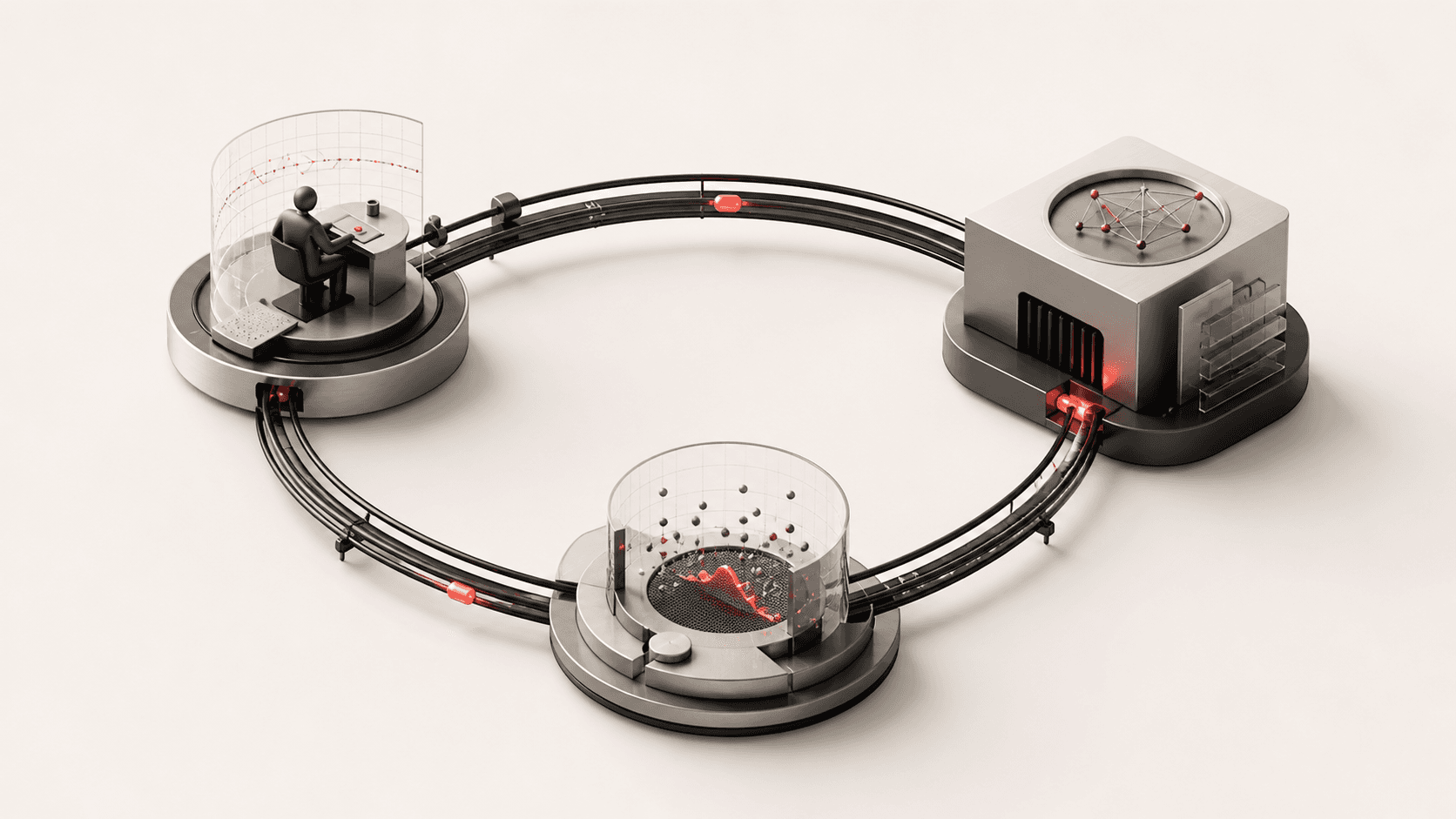
One continuous loop. Each stage leaves evidence for the next one, while feedback from production improves the next decision.

01 / Workflow discovery

Map the costly workflow.

Trace people, systems, decisions, exceptions, and cost.

02 / System blueprint

Define the system and KPI.

Set architecture, decision boundaries, ownership, and proof.

03 / Build & integrate

Build the complete system.

Ship agents, integrations, controls, interface, and evaluation.

04 / Production release

Put it into production safely.

Introduce access controls, monitoring, fallbacks, and review.

05 / Improvement loop

Improve from live evidence.

Review exceptions against KPI and feed learning into the next loop.

Workflow discovery active / reading the work before changing it

What we build

Systems that move work forward.

Every engagement is shaped around the work people need to complete, the systems they already rely on, and a clear route into daily operation.

01

AI workflows

Connect repeatable handoffs across the systems your team already runs.

02

AI agents

Give teams a controlled way to act on information, tools, and exceptions.

03

RAG and knowledge systems

Make internal context usable with sources and clear review points.

04

Agentic operating systems

Coordinate workflows that need data, decisions, and human ownership.

About us

Built with the people who have to run the system.

Harnessloop is led by Bartosz Ludera. We work with operating teams from the first workflow map through release and the improvements that follow.

Our delivery approach is shaped by production work, not innovation theatre. The system needs a visible owner, clear boundaries, and evidence that it is helping the work move.

Before we start

Answers before the first call.

What makes a workflow a good first project?

It has a clear owner, repeats often enough to matter, and creates an obvious cost when it waits or goes wrong. We map those conditions before we commit to a build.

Do we need to replace our existing systems?

No. Systems of record stay in place. The work is to connect the right context, actions, approvals, and audit trail around them.

How do you keep people in control?

The decision point is defined before implementation. The system can prepare, retrieve, route, and monitor. Your team keeps the decisions that need authority or judgment.

What can a 2-4 week increment include?

A mapped workflow, the first production-ready path, agreed controls, and evidence from the people who will use it. The scope is small enough to judge, not a promise to solve everything at once.

Which systems can you connect to?

We work with the systems that already hold the work: CRMs, helpdesks, internal knowledge, document stores, operational tools, and custom APIs. The first step is confirming access and boundaries.

How do you handle sensitive data and security?

We define the access model, data boundaries, logging, and approval steps before implementation. The system only receives the context it needs for its part of the work.

What happens after the first release?

We observe real exceptions, review traces and outcomes, then decide what improves next. The system keeps changing with the work instead of being handed over and forgotten.

The LangChain stack in practice

Frameworks give the system a structure. They do not replace the operating work.

We use the stack where it makes an AI system easier to inspect, change, and run with confidence.

LangChainConnects models, tools, data, and the actions an agent can take.
LangGraphMakes workflow state, approvals, and exception paths explicit.
LangSmithShows traces and evaluations so the team can improve what happens in production.

Official LangChain Ambassador

Framework expertise, closer to the source.

We stay close to the people and releases behind the framework. Clients get earlier product context, practical implementation knowledge, and a direct route to the founding team when an engagement calls for it.

01

Earlier context

Direction before it becomes a delivery concern.

02

Practical knowledge

Guidance from real implementation work.

03

Direct route

Access to the people building the framework.

LangChain in production

Used by teams at

Why Harnessloop

Built as an AI-native company, not a conventional agency with AI added on.

Our operating model is part of what you buy. It changes how quickly the work gets real, how close it stays to your team, and what you can judge before committing further.

The operating loop

AI moves the work. People own the call.

Every delivery cycle connects operational input, AI execution, human judgment, and live feedback. That is how an AI system becomes part of a company instead of a separate experiment.

  1. 01Observe the real work
  2. 02Run the repeatable work through AI
  3. 03Review decisions with the people accountable
  4. 04Feed outcomes into the next release
A circular operating loop connecting human judgment, AI execution, and operational feedback.
Human judgmentAI executionLive feedback
01

AI-native company

The delivery team works the way the system will work.

AI handles research, drafting, testing, and observation inside the delivery loop. People keep the decisions that need judgment or accountability. You get progress without losing control.

02

2-4 week increments

A working increment before a long programme.

We define a slice small enough to ship and judge in two to four weeks, rather than disappearing into a three to six month build. You see evidence early and choose the next step with it.

03

Forward-deployed engineering

The build happens close to the operation.

We work alongside users, source systems, and real exceptions. You get something shaped by live work, not a polished demo that needs to be rebuilt after handover.

04

LangChain Ambassadors

Framework expertise when the technical stakes rise.

Our LangChain ambassador relationship keeps the implementation current and gives us a direct route to framework experts. You get fewer blind spots in architecture and delivery.

See the model in context

How we build a company with AI from the ground up.

A useful perspective from Y Combinator on the operating model behind an AI-native company.

Watch on YouTube

Start with the work

Bring the workflow that needs attention.

Pick a time for a working session or send a short brief. Either way, we will come prepared to understand where the work gets stuck.

Talk through the work

Book a 20-minute consultation.

Bring the workflow that feels slow or fragile. We will determine whether it is a sensible candidate for an AI system.

Bartosz LuderaBartosz LuderaFounder, Harnessloop

Send a workflow brief

Prefer to write it down?

Tell us where work waits, repeats, or falls through the cracks.